
Behavioral Finance and Everyday Money Decisions: Why We Often Act Against Our Own Financial Interests
Introduction: Money Is Not Just About Math
Traditional finance assumes that people are rational. In theory, individuals carefully evaluate all available information, compare risks and returns, and then choose the option that maximizes their financial well-being. Real life looks very different. People panic during market downturns, chase trends at market peaks, overspend on things they do not need, and postpone saving for the future even when they know it is important.
Behavioral finance exists because these patterns are too consistent to ignore. It is a field that combines economics, psychology, and finance to explain how emotions, mental shortcuts, and cognitive biases influence financial decisions. Rather than assuming people are perfectly logical, behavioral finance studies how people actually behave when dealing with money.
This article explores the core ideas of behavioral finance in a practical and accessible way. It explains the most common psychological biases, how they affect everyday financial decisions, and what individuals can do to reduce their negative impact. The goal is not to eliminate emotions from money decisions, but to understand them well enough to make more balanced and informed choices.
1. What Is Behavioral Finance?
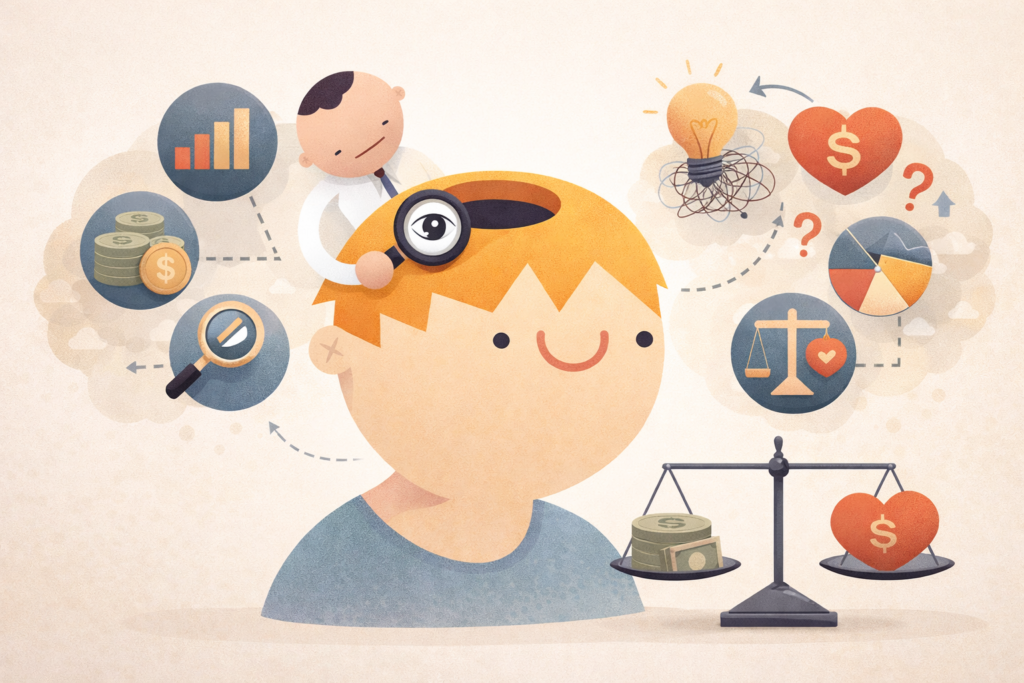
Behavioral finance studies systematic patterns in financial behavior that cannot be fully explained by traditional economic models. These patterns often arise from:
- Cognitive limitations (we cannot process unlimited information)
- Emotional responses (fear, greed, regret, overconfidence)
- Social influences (following the crowd, social comparison)
Instead of treating these factors as “errors,” behavioral finance treats them as natural features of human decision-making.
A Brief Historical Context
Although the field gained popularity in the late 20th century, its roots go back several decades:
- Herbert Simon introduced the idea of bounded rationality, arguing that people aim for decisions that are “good enough” rather than optimal
- Daniel Kahneman and Amos Tversky developed Prospect Theory, showing that people evaluate gains and losses asymmetrically
- Richard Thaler applied psychological insights to economic behavior, helping to formalize behavioral economics
Their work demonstrated that predictable psychological biases systematically influence financial choices.
2. Why Psychological Biases Matter in Personal Finance
Personal finance decisions are frequent, emotional, and closely tied to life goals. Unlike professional investors who may follow strict models, individuals often make decisions under stress, uncertainty, or social pressure.
Psychological biases matter because they can:
- Lead to poor long-term outcomes despite good intentions
- Create repeated financial mistakes (overspending, under-saving)
- Increase vulnerability to fraud, speculation, or financial bubbles
Understanding these biases is the first step toward managing them.
3. Key Psychological Biases That Shape Financial Decisions

Below are some of the most common and well-documented biases in behavioral finance, illustrated with everyday examples.
3.1 Loss Aversion: The Pain of Losing Is Stronger Than the Joy of Gaining
Loss aversion refers to the tendency to feel losses more intensely than gains of the same size. Losing $100 typically feels more painful than the pleasure of gaining $100.
How it affects personal finance:
- Investors hold losing investments too long to avoid “locking in” losses
- People avoid investing altogether because they fear short-term losses
- Individuals reject reasonable financial risks, even when the long-term odds are favorable
Loss aversion can make people overly cautious, leading to missed opportunities for growth.
3.2 Overconfidence Bias: Believing We Know More Than We Do
Overconfidence bias occurs when individuals overestimate their knowledge, skills, or ability to predict outcomes.
Common financial effects:
- Frequent trading, leading to higher transaction costs
- Underestimating risks or ignoring contrary information
- Believing one can consistently “beat the market”
Research shows that overconfident investors often achieve lower returns than more cautious ones, largely due to excessive trading.
3.3 Anchoring: Relying Too Heavily on the First Number
Anchoring happens when people rely strongly on an initial piece of information (the “anchor”) when making decisions, even if it is irrelevant or outdated.
Examples in daily finance:
- Judging a stock’s value based on its past high price
- Considering a discount attractive simply because the original price was high
- Fixating on a past salary when negotiating compensation
Anchors influence perception and can distort objective evaluation.
3.4 Mental Accounting: Treating Money Differently Based on Label
Mental accounting describes the tendency to assign money to separate “accounts” in our minds, even though money is fungible.
Typical behaviors:
- Spending bonuses more freely than regular income
- Keeping money in low-interest savings while carrying high-interest debt
- Treating tax refunds as “free money”
While mental accounting can help with budgeting, it can also lead to inefficient financial choices.
3.5 Herd Behavior: Following the Crowd
Herd behavior occurs when individuals mimic the actions of a larger group, often assuming the group must know something they do not.
Financial consequences:
- Buying assets because “everyone else is buying”
- Panic selling during market downturns
- Participating in speculative bubbles
Social influence is powerful, especially when uncertainty is high.
3.6 Present Bias: Preferring Immediate Rewards
Present bias refers to the tendency to prioritize immediate gratification over long-term benefits.
In personal finance, this leads to:
- Under-saving for retirement
- Excessive use of credit
- Difficulty sticking to long-term financial plans
The future feels distant and abstract, while current desires feel urgent and real.
4. Behavioral Biases Across Major Financial Decisions
Psychological biases do not operate in isolation. They appear repeatedly across different areas of personal finance.
4.1 Saving and Spending
- Present bias encourages spending now rather than saving
- Mental accounting can justify unnecessary purchases
- Social comparison increases lifestyle inflation
4.2 Investing
- Loss aversion causes investors to avoid volatility
- Overconfidence leads to excessive trading
- Anchoring distorts valuation judgments
4.3 Borrowing and Debt
- Optimism bias underestimates future repayment difficulty
- Present bias encourages borrowing for short-term comfort
- Framing effects make minimum payments seem sufficient
4.4 Insurance and Risk Management
- Probability neglect leads to under- or over-insuring
- Emotional reactions influence perceived risk more than statistics
5. Practical Tips to Reduce the Impact of Biases
Behavioral finance does not suggest that people can become perfectly rational. Instead, it focuses on designing habits and systems that work with human psychology.
Simple and Effective Strategies
- Automate good decisions: automatic savings and investments reduce reliance on willpower
- Use rules, not emotions: pre-defined investment rules help during market stress
- Reframe choices: focus on long-term goals rather than short-term outcomes
- Limit information overload: too much news can amplify emotional reactions
- Create friction for bad habits: make impulsive spending less convenient
These small structural changes often matter more than self-control alone.
6. The Role of Financial Education and Awareness
Financial literacy traditionally focuses on products, formulas, and technical knowledge. Behavioral finance adds another layer: self-awareness.
Effective financial education should include:
- Understanding common biases
- Recognizing emotional triggers
- Learning how decision environments shape behavior
When people understand why they make certain financial mistakes, they are better equipped to avoid repeating them.
7. Behavioral Finance in Everyday Life: A Balanced Perspective
It is important to note that biases are not always harmful. In some cases:
- Heuristics save time and cognitive effort
- Emotional comfort provides psychological well-being
- Social norms encourage responsible behavior
The objective is not to eliminate biases, but to prevent them from systematically harming long-term financial outcomes.
Conclusion: Making Peace With Human Nature
Behavioral finance shows that financial mistakes are not simply the result of ignorance or lack of discipline. They are often the natural outcome of how the human mind works. Emotions, shortcuts, and social influences shape financial decisions every day.
By understanding common psychological biases, individuals can design better financial habits, make more thoughtful choices, and reduce the gap between good intentions and actual behavior. Small adjustments in decision-making processes can lead to meaningful improvements over time.
Personal finance is not only about numbers. It is about people. Behavioral finance helps bridge the gap between financial theory and real human behavior, offering practical insights for more sustainable and realistic financial decisions.
References
- Kahneman, D. (2011). Thinking, Fast and Slow. Farrar, Straus and Giroux
- Tversky, A., & Kahneman, D. (1979). Prospect Theory: An Analysis of Decision under Risk. Econometrica
- Thaler, R. H. (2015). Misbehaving: The Making of Behavioral Economics. W. W. Norton & Company
- Barber, B. M., & Odean, T. (2001). Boys Will Be Boys: Gender, Overconfidence, and Common Stock Investment. The Quarterly Journal of Economics
- OECD (2020). OECD/INFE Consumer Policy and Financial Education Review