
Monetary Policy Outlook 2026: How Markets Are Repricing Risk After the Federal Reserve’s Latest Move
In early 2026, the U.S. Federal Reserve once again demonstrated its central role in shaping global financial conditions. The latest policy decision by the Federal Reserve—adjusting its policy rate guidance while signaling a recalibration of balance sheet strategy—has triggered immediate and nuanced reactions across bond, equity, currency, and commodity markets.
While the headline rate move itself was widely anticipated, the accompanying forward guidance and economic projections prompted investors to reassess growth assumptions, inflation trajectories, and risk premia. In a global environment still digesting the post-pandemic cycle, geopolitical fragmentation, and structurally higher fiscal deficits, the implications of U.S. monetary policy in 2026 extend well beyond domestic borders.
This article examines:
- The context behind the Federal Reserve’s latest decision
- Market reactions across asset classes
- Implications for inflation, employment, and financial stability
- Global spillovers
- Key scenarios for the remainder of 2026
1. The Policy Decision in Context
A Late-Cycle Adjustment
By 2026, the U.S. economy has moved beyond the acute inflationary pressures of 2022–2023 but continues to operate in an environment of elevated price stickiness relative to the pre-pandemic era. Headline inflation has moderated significantly from its peak, yet core measures remain above the Fed’s 2% target.
The latest move by the Federal Open Market Committee (FOMC) reflects three core assessments:
- Inflation is decelerating, but not decisively converging to target.
- Labor market tightness has eased but remains structurally firm.
- Financial conditions had loosened more than policymakers intended.
In its statement, the Fed emphasized “data dependency,” reinforcing that policy will remain restrictive until there is sustained confidence that inflation is returning to target.
The Fed’s Dual Mandate
Under its congressional mandate, the Federal Reserve is tasked with:
- Maximum employment
- Stable prices
Balancing these objectives has become increasingly complex in 2026, as demographic shifts, supply chain reconfiguration, and fiscal expansion reshape macroeconomic dynamics.
2. Immediate Market Reactions
Markets responded within minutes of the announcement. However, the most consequential adjustments occurred during the press conference and in the days that followed, as investors parsed nuances in tone and projections.
Treasury Yields: Curve Repricing
The U.S. Treasury market saw notable movements:
- Short-term yields rose modestly, reflecting expectations that rates may remain elevated longer than previously assumed.
- Long-term yields moved less dramatically, suggesting markets believe inflation risks are contained over the long horizon.
The result was a partial flattening of the yield curve. Analysts noted that while recession fears have diminished compared to 2023–2024, the curve continues to signal tight monetary conditions.
Equity Markets: Sector Divergence
U.S. equity indices initially declined before stabilizing. The reaction was uneven across sectors:
- Technology and growth stocks weakened, reflecting sensitivity to higher discount rates.
- Financials showed relative resilience due to improved net interest margin prospects.
- Defensive sectors such as utilities and consumer staples saw inflows amid uncertainty.
Valuations remain elevated by historical standards, meaning markets are particularly sensitive to shifts in long-term rate expectations.
U.S. Dollar: Renewed Strength
The U.S. dollar appreciated modestly following the decision, reflecting:
- Higher real yield differentials
- Perceived relative economic resilience
- Continued demand for dollar-denominated assets
A stronger dollar exerts tightening pressure globally, particularly on emerging markets with dollar-denominated debt.
Commodities: Mixed Signals
Commodity markets reacted in a differentiated manner:
- Oil prices remained largely stable, influenced more by geopolitical supply dynamics than monetary policy.
- Gold declined slightly as real yields rose.
- Industrial metals reflected cautious optimism regarding growth.
3. Inflation Dynamics: Are We Entering a New Regime?
A central question for 2026 is whether inflation is structurally higher than in the pre-2020 decade.
Structural Drivers
Several long-term factors complicate disinflation:
- Deglobalization and supply chain diversification
- Energy transition investment requirements
- Persistent fiscal deficits
- Labor market demographics
The Fed’s projections suggest inflation will gradually converge toward target, but not at the rapid pace observed in earlier tightening cycles.
Real Rates and Neutral Policy
An important debate among economists concerns the “neutral rate” (r*). If the neutral rate is structurally higher than during the 2010s, policy may need to remain restrictive for longer to achieve price stability.
In 2026, markets appear to be adjusting to the possibility that:
- The ultra-low rate environment of the 2010s may not return
- Real yields could remain positive and historically elevated
This repricing has implications for asset allocation globally.
4. Labor Market and Growth Outlook
The labor market remains central to the Fed’s calculus.
Employment Conditions
Indicators show:
- Slower payroll growth
- Moderating wage gains
- Stable unemployment rates
While no sharp deterioration is evident, job market cooling is gradual rather than abrupt.
GDP Growth
Economic growth has moderated but remains positive. Consumer spending is supported by:
- Healthy household balance sheets
- Rising real incomes
- Continued fiscal spending programs
However, business investment shows signs of caution, particularly in interest-sensitive sectors such as commercial real estate.
5. Financial Stability Considerations
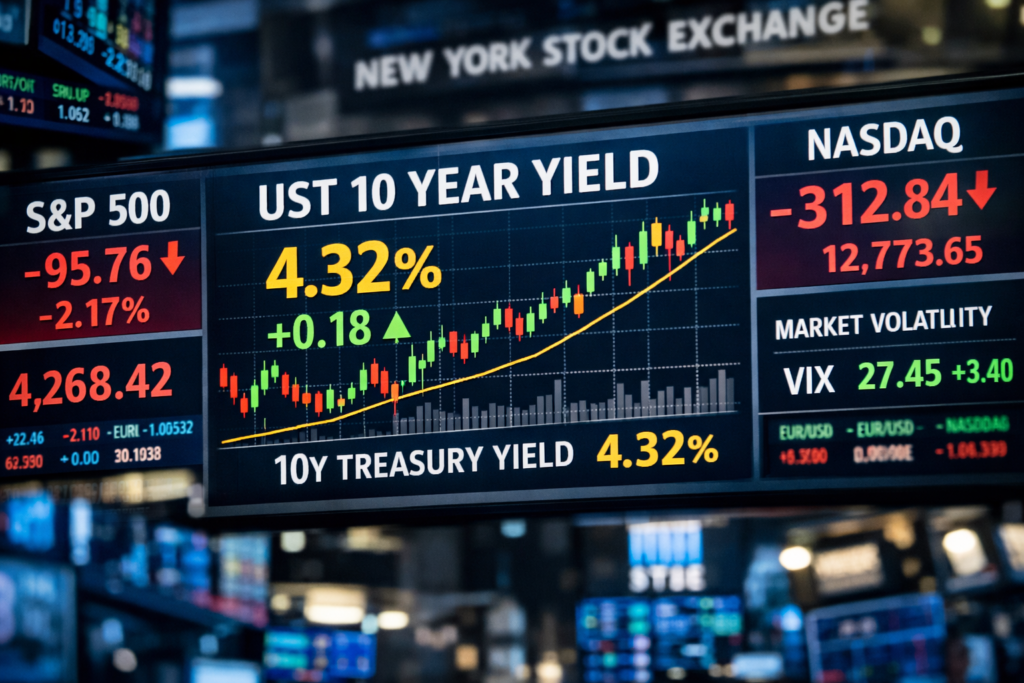
Beyond inflation and employment, the Fed must monitor financial stability risks.
Banking Sector
Since the regional banking stress episodes earlier in the decade, regulatory oversight has tightened. Capital buffers are stronger, but:
- Higher rates increase funding costs
- Commercial real estate exposure remains a concern
Corporate Debt
Corporate leverage is manageable at aggregate levels, but refinancing risk has risen as low-rate era debt matures into a higher-rate environment.
Credit spreads have widened slightly following the Fed’s announcement, though not to distress levels.
6. Global Spillovers
The Federal Reserve’s actions reverberate globally.
Emerging Markets
A stronger dollar and higher U.S. yields create:
- Capital outflow pressure
- Higher debt servicing costs
- Currency depreciation risks
Countries with solid external balances are more resilient, but fragile economies face tightening financial conditions.
Europe and Japan
The policy stance of the European Central Bank and the Bank of Japan remains comparatively accommodative, though both face domestic inflation pressures.
Policy divergence may widen interest rate differentials further, influencing global capital flows.
7. Market Positioning: What Investors Are Pricing In
Futures markets indicate expectations of:
- Limited additional tightening
- A prolonged plateau in policy rates
- Gradual easing beginning late 2026 or early 2027
However, this path is contingent on inflation data.
Risk Scenarios

Key upside and downside risks include:
Upside Inflation Risk
- Energy price shocks
- Wage reacceleration
- Fiscal stimulus
Downside Growth Risk
- Sharp credit contraction
- Housing market weakness
- Global demand slowdown
8. Key Takeaways
- The Federal Reserve remains firmly focused on inflation control.
- Markets are adjusting to a “higher-for-longer” rate environment.
- Yield curve movements suggest restrained long-term inflation expectations.
- Equity market reactions reflect valuation sensitivity to real yields.
- Global financial conditions are tightening moderately due to dollar strength.
9. Outlook for the Remainder of 2026
The trajectory of monetary policy through the rest of 2026 will depend on:
- Monthly inflation prints
- Labor market cooling pace
- Financial stability indicators
- Global macro shocks
If inflation continues to ease steadily, the Fed may maintain its current stance before cautiously pivoting. However, any reacceleration could delay normalization.
Investors should expect:
- Continued volatility in rate-sensitive assets
- Heightened attention to economic data releases
- Ongoing repricing of long-term equilibrium rates
Conclusion: A Structural Reset, Not a Temporary Phase
The Federal Reserve’s latest move in 2026 marks less of a dramatic pivot and more of a strategic recalibration. Markets are gradually adapting to a new macroeconomic regime characterized by:
- Structurally higher real interest rates
- Moderately persistent inflation
- Reduced likelihood of ultra-accommodative policy
The adjustment process remains orderly but incomplete. As financial markets internalize the implications of a “higher-for-longer” environment, volatility will likely persist.
Ultimately, 2026 may be remembered not for a single rate decision, but for the broader normalization of monetary policy expectations after more than a decade of extraordinary accommodation.