
Stocks, Bonds, and Derivatives Explained: A Practical Guide to Global Financial Markets
Why Financial Markets Matter More Than You Think
Whether you actively invest or not, global financial markets influence your daily life more than you might realize. From pension funds and insurance policies to mortgage rates and currency values, the movement of financial instruments shapes economic outcomes across countries and generations.
At the core of these markets are three foundational instruments:
- Stocks
- Bonds
- Derivatives
They differ in structure, purpose, and risk, yet they are deeply interconnected. Understanding how they work—at a basic, practical level—helps demystify financial news, market volatility, and investment conversations that often feel overly complex.
This article offers a clear, accessible overview of stocks, bonds, and derivatives in the context of global financial markets, without relying on advanced mathematics or technical jargon.
1. A Big-Picture View of Global Financial Markets

Before diving into individual instruments, it helps to understand what financial markets actually do.
What Are Financial Markets?
In simple terms, financial markets are platforms—physical or digital—where:
- Capital is raised
- Risks are transferred
- Prices are discovered
- Liquidity is provided
They connect savers (households, institutions) with borrowers (companies, governments).
Key Functions of Global Markets
- Allocating capital to productive uses
- Allowing governments and firms to fund operations
- Enabling investors to grow wealth
- Facilitating global trade and investment
Without these markets, modern economies would struggle to function efficiently.
2. Stocks: Ownership and Growth
What Is a Stock?
A stock represents partial ownership in a company. When you buy a stock, you become a shareholder, meaning you have a claim—however small—on the company’s assets and future profits.
Why Companies Issue Stocks
Companies issue stocks primarily to:
- Raise capital for expansion
- Fund research and development
- Reduce reliance on debt
Unlike loans, equity financing does not require fixed repayments.
Why Investors Buy Stocks
Investors are attracted to stocks because of their potential for:
- Capital appreciation (price increases)
- Dividends (profit distributions)
- Long-term wealth creation
Historically, equities have delivered higher long-term returns than most other asset classes, albeit with higher volatility.
Common Types of Stocks
- Common stocks: Voting rights, variable dividends
- Preferred stocks: Fixed dividends, limited voting rights
Stocks in Global Markets
Stock markets operate worldwide, from major exchanges like:
- New York Stock Exchange (NYSE)
- London Stock Exchange (LSE)
- Tokyo Stock Exchange (TSE)
to emerging market exchanges in Asia, Africa, and Latin America.
Together, they reflect investor expectations about economic growth, corporate profitability, and global stability.
3. Bonds: Lending and Stability
What Is a Bond?
A bond is essentially a loan made by an investor to a borrower, usually:
- Governments
- Corporations
- Public institutions
In return, the issuer promises to:
- Pay periodic interest (coupon)
- Repay the principal at maturity
Why Bonds Exist
Bonds allow issuers to:
- Finance infrastructure and public spending
- Manage cash flow
- Fund long-term projects
For investors, bonds often provide:
- Predictable income
- Lower risk compared to stocks
- Portfolio stability
Major Types of Bonds
- Government bonds: Issued by national governments, generally lower risk
- Corporate bonds: Issued by companies, higher yields but higher risk
- Municipal bonds: Issued by local governments, often tax-advantaged
Risk Factors in Bond Investing
While bonds are often considered safer than stocks, they are not risk-free:
- Interest rate risk: Bond prices fall when rates rise
- Credit risk: Issuer may default
- Inflation risk: Fixed payments lose purchasing power
Bonds in a Global Context
Global bond markets are larger than stock markets and play a crucial role in:
- Monetary policy transmission
- Government financing
- International capital flows
They are closely watched by central banks and policymakers worldwide.
4. Stocks vs. Bonds: Key Differences at a Glance
To clarify their roles, consider the following comparison:
- Ownership vs. Lending
- Stocks = ownership
- Bonds = lending
- Return Profile
- Stocks = higher potential, higher volatility
- Bonds = lower potential, more stability
- Income
- Stocks = dividends (not guaranteed)
- Bonds = fixed interest payments
- Priority
- Bondholders are paid before shareholders if a company fails
Most long-term portfolios include both to balance growth and stability.
5. Derivatives: Tools, Not Assets
What Are Derivatives?
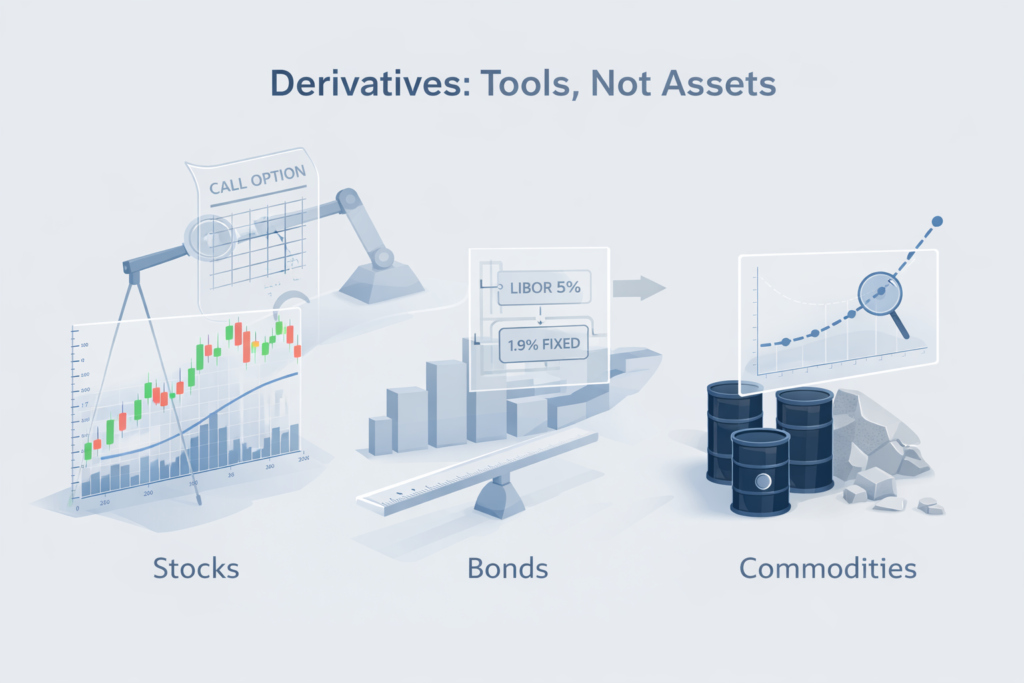
Derivatives are financial contracts whose value is derived from an underlying asset, such as:
- Stocks
- Bonds
- Commodities
- Currencies
- Interest rates
They do not represent ownership or lending by themselves.
Common Types of Derivatives
- Futures: Agreements to buy or sell at a set price in the future
- Options: Rights (but not obligations) to buy or sell
- Swaps: Agreements to exchange cash flows
Why Derivatives Exist
Derivatives are used mainly for:
- Risk management (hedging)
- Price discovery
- Market efficiency
For example, airlines use derivatives to hedge fuel costs, while exporters hedge currency risk.
Speculation vs. Hedging
Derivatives can be used responsibly—or recklessly:
- Hedging reduces uncertainty
- Speculation amplifies risk
This dual nature explains why derivatives are both essential and controversial.
6. How These Instruments Interact in Global Markets
Stocks, bonds, and derivatives do not operate in isolation.
Interconnections
- Interest rate changes affect both stocks and bonds
- Derivatives are often built on stocks and bonds
- Global events trigger simultaneous movements across markets
For example, a central bank rate hike may:
- Lower bond prices
- Pressure stock valuations
- Increase derivative activity for hedging
Understanding these links helps explain market reactions to news and policy decisions.
7. The Role of Financial Markets in Everyday Life
Even if you never trade directly, financial markets impact you through:
- Pension funds
- Insurance products
- Employment conditions
- Housing costs
- Currency exchange rates
Your retirement savings are likely invested in a mix of stocks and bonds, often managed by professionals using derivatives to control risk.
8. Common Myths and Misunderstandings
“Stocks Are Just Gambling”
While short-term trading can resemble speculation, long-term investing in stocks reflects participation in economic growth.
“Bonds Are Always Safe”
Bonds carry risks, especially during periods of rising inflation or fiscal stress.
“Derivatives Are Dangerous by Nature”
Derivatives are tools. Their risk depends on how they are used, not on their existence.
Conclusion: Building Financial Understanding Step by Step
Stocks, bonds, and derivatives form the backbone of global financial markets. Each serves a distinct purpose:
- Stocks drive growth
- Bonds provide stability
- Derivatives manage risk
Understanding these instruments does not require advanced finance knowledge—only curiosity and a willingness to learn step by step.
As global markets become more interconnected and accessible, basic financial literacy is no longer optional. It is a practical skill that empowers individuals to better interpret economic events, manage personal finances, and engage confidently with the financial world.
References (for further reading)
- Investopedia – Stocks, Bonds, and Derivatives
- CFA Institute – Introduction to Financial Markets
- World Federation of Exchanges – Market Structure Overview
- IMF – Global Financial Stability Reports