
AI in Clinical Diagnostics: From Decision Support to Diagnostic Authority
A Structural Shift in Medical Diagnostics
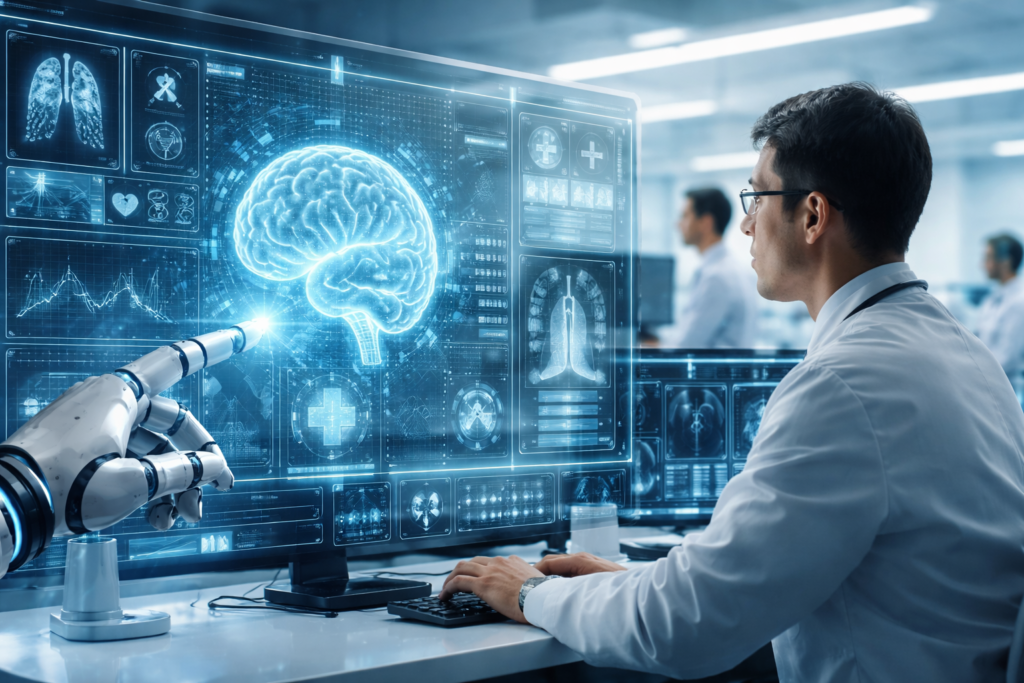
Artificial Intelligence (AI) is no longer an experimental add-on in healthcare diagnostics. Over the past decade, it has transitioned from narrow, task-specific tools—such as image recognition algorithms—into increasingly sophisticated systems capable of supporting, and in some cases rivaling, clinician decision-making. This evolution marks a structural shift in how diseases are detected, classified, and monitored across healthcare systems worldwide.
Driven by advances in machine learning, deep neural networks, and large-scale health data availability, AI diagnostic systems are now deployed across radiology, pathology, cardiology, oncology, ophthalmology, and primary care triage. Their growing role raises critical questions about accuracy, accountability, regulatory oversight, and the future relationship between clinicians and intelligent systems.
This article examines how AI is expanding its role in healthcare diagnostics, the technologies underpinning this expansion, real-world clinical applications, and the systemic challenges that accompany adoption.
The Technological Foundations of AI Diagnostics
Core AI Technologies Powering Diagnostics
Modern diagnostic AI systems rely on a convergence of several technical domains:
- Machine Learning (ML): Enables pattern recognition from large datasets without explicit programming.
- Deep Learning: Uses multi-layer neural networks, particularly effective in image, signal, and speech analysis.
- Natural Language Processing (NLP): Extracts diagnostic signals from unstructured clinical notes, pathology reports, and electronic health records (EHRs).
- Computer Vision: Interprets medical images such as X-rays, CT scans, MRIs, retinal scans, and histopathology slides.
These technologies are trained on vast labeled datasets, often containing millions of images or patient records, allowing systems to detect subtle features that may escape human observation.
Data as the Primary Diagnostic Asset
The expansion of AI diagnostics is inseparable from data growth:
- Digitization of medical imaging
- Widespread adoption of EHR systems
- Increased availability of genomic and proteomic data
- Real-time physiological data from wearable devices
Healthcare has become a data-dense environment, providing the raw material necessary for AI systems to learn complex disease patterns.
Clinical Domains Where AI Diagnostics Are Expanding
1. Medical Imaging and Radiology
Radiology remains the most mature and widely adopted domain for AI diagnostics.
Key capabilities include:
- Detection of lung nodules, fractures, strokes, and hemorrhages
- Prioritization of urgent cases (triage)
- Quantitative image analysis for disease progression
Studies have shown AI systems achieving diagnostic accuracy comparable to expert radiologists in specific tasks, particularly in mammography and chest imaging.
However, AI tools are primarily deployed as decision support systems, augmenting rather than replacing radiologists.
2. Pathology and Cancer Diagnostics
Digital pathology has enabled AI to analyze whole-slide images at cellular resolution.
Applications include:
- Tumor detection and grading
- Identification of biomarkers
- Prediction of treatment response
AI systems can scan pathology slides far faster than human pathologists and consistently apply diagnostic criteria, reducing inter-observer variability.
This capability is especially valuable in oncology, where diagnostic precision directly impacts treatment strategy.
3. Ophthalmology and Preventive Screening
AI diagnostics have gained regulatory approval in ophthalmology, particularly for diabetic retinopathy screening.
Notably:
- Autonomous AI systems can identify retinal disease without clinician input
- These tools are increasingly deployed in primary care and community settings
This represents a significant shift: AI not only assisting clinicians, but independently delivering diagnostic decisions under regulated conditions.
4. Cardiology and Signal Analysis
AI excels in analyzing time-series data such as ECGs and heart rhythm signals.
Examples include:
- Detection of atrial fibrillation from wearable devices
- Prediction of heart failure risk
- Identification of subtle ECG patterns associated with structural heart disease
Some AI models have demonstrated the ability to detect conditions that are clinically invisible using traditional diagnostic criteria.
5. Multimodal and System-Level Diagnostics
The latest generation of AI systems integrates multiple data types:
- Imaging
- Laboratory results
- Clinical notes
- Genomic data
This multimodal approach enables a more holistic diagnostic assessment, moving closer to real-world clinical reasoning.
From Assistance to Authority: A Shifting Role
Evolution of Clinical Trust
Historically, AI diagnostics were positioned as tools that:
- Reduce workload
- Improve efficiency
- Minimize human error
Today, their role is expanding toward:
- Independent screening
- Risk stratification
- Diagnostic recommendation
This shift raises questions about epistemic authority in medicine—who or what is considered a reliable source of diagnostic truth.
Human-AI Collaboration Models
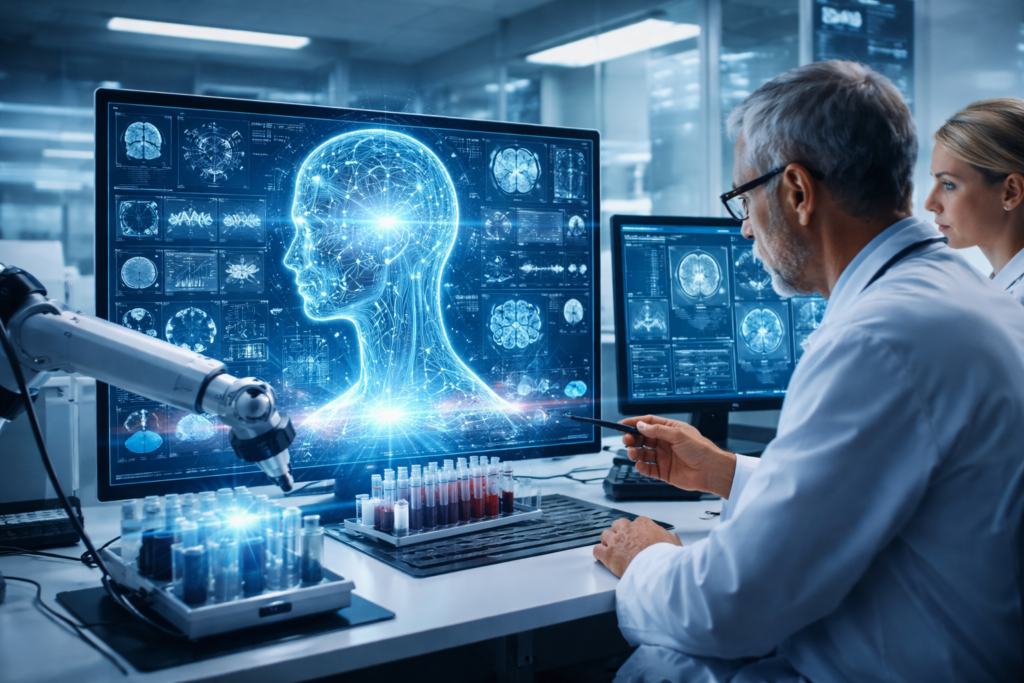
Emerging deployment models include:
- AI-first screening: AI evaluates cases before clinician review
- Concurrent review: AI and clinician assess simultaneously
- Clinician-override systems: AI proposes diagnoses subject to human confirmation
Evidence suggests that combined human-AI decision-making often outperforms either alone, particularly in complex diagnostic scenarios.
Regulatory, Ethical, and Clinical Challenges
Validation and Generalizability
One of the most significant challenges is ensuring that AI diagnostic models:
- Perform consistently across populations
- Are not biased by training data
- Remain accurate over time as clinical practice evolves
Models trained on narrow datasets may fail in real-world settings, particularly in underrepresented populations.
Explainability and Clinical Accountability
Deep learning systems are often criticized as “black boxes.”
Key concerns include:
- Lack of transparency in decision pathways
- Difficulty explaining AI recommendations to patients
- Unclear liability when AI-influenced decisions result in harm
Regulators increasingly require explainability, auditability, and post-market surveillance.
Integration into Clinical Workflow
Adoption is not purely a technical issue. Successful deployment requires:
- Seamless integration with existing EHR systems
- Minimal disruption to clinician workflow
- Training and change management
Poorly integrated AI tools risk increasing cognitive burden rather than reducing it.
Global Impact and Health System Implications
Expanding Access in Resource-Limited Settings
AI diagnostics have the potential to:
- Address specialist shortages
- Enable screening in rural and underserved areas
- Reduce diagnostic delays
In low- and middle-income countries, AI-powered screening tools may significantly improve early disease detection.
Economic and Workforce Considerations
Contrary to fears of widespread clinician replacement, current evidence suggests AI is more likely to redefine roles rather than eliminate them.
Expected impacts include:
- Shift toward higher-value clinical tasks
- Increased demand for AI-literate healthcare professionals
- New roles in clinical AI governance and oversight
The Road Ahead: What Comes Next
Several trends are likely to shape the future of AI diagnostics:
- Foundation models for healthcare: Large, generalizable models trained on diverse clinical data
- Continuous learning systems: AI that updates with new data under regulatory supervision
- Personalized diagnostics: Integration of genomics and longitudinal patient data
- Stronger regulation: Clearer frameworks for safety, efficacy, and accountability
The trajectory suggests AI will become an embedded layer of diagnostic infrastructure rather than a standalone tool.
A Redefinition, Not a Replacement
Artificial intelligence is fundamentally redefining healthcare diagnostics—reshaping how diseases are detected, interpreted, and managed. Its expanding role reflects both technological maturity and systemic pressures within global healthcare systems.
Yet, AI does not signal the obsolescence of human clinicians. Instead, it introduces a new diagnostic paradigm in which expertise is distributed across human judgment, data-driven algorithms, and institutional oversight.
The central challenge ahead is not whether AI should be used in diagnostics, but how it can be governed, integrated, and trusted to improve patient outcomes without compromising ethical and clinical standards.
References
- World Health Organization (WHO) – Ethics and Governance of Artificial Intelligence for Health
- Nature Medicine – AI in medical imaging and diagnostics
- The Lancet Digital Health – Clinical validation of AI diagnostic systems
- U.S. Food and Drug Administration (FDA) – AI/ML-based medical device guidance
- National Institutes of Health (NIH) – AI and data science in healthcare