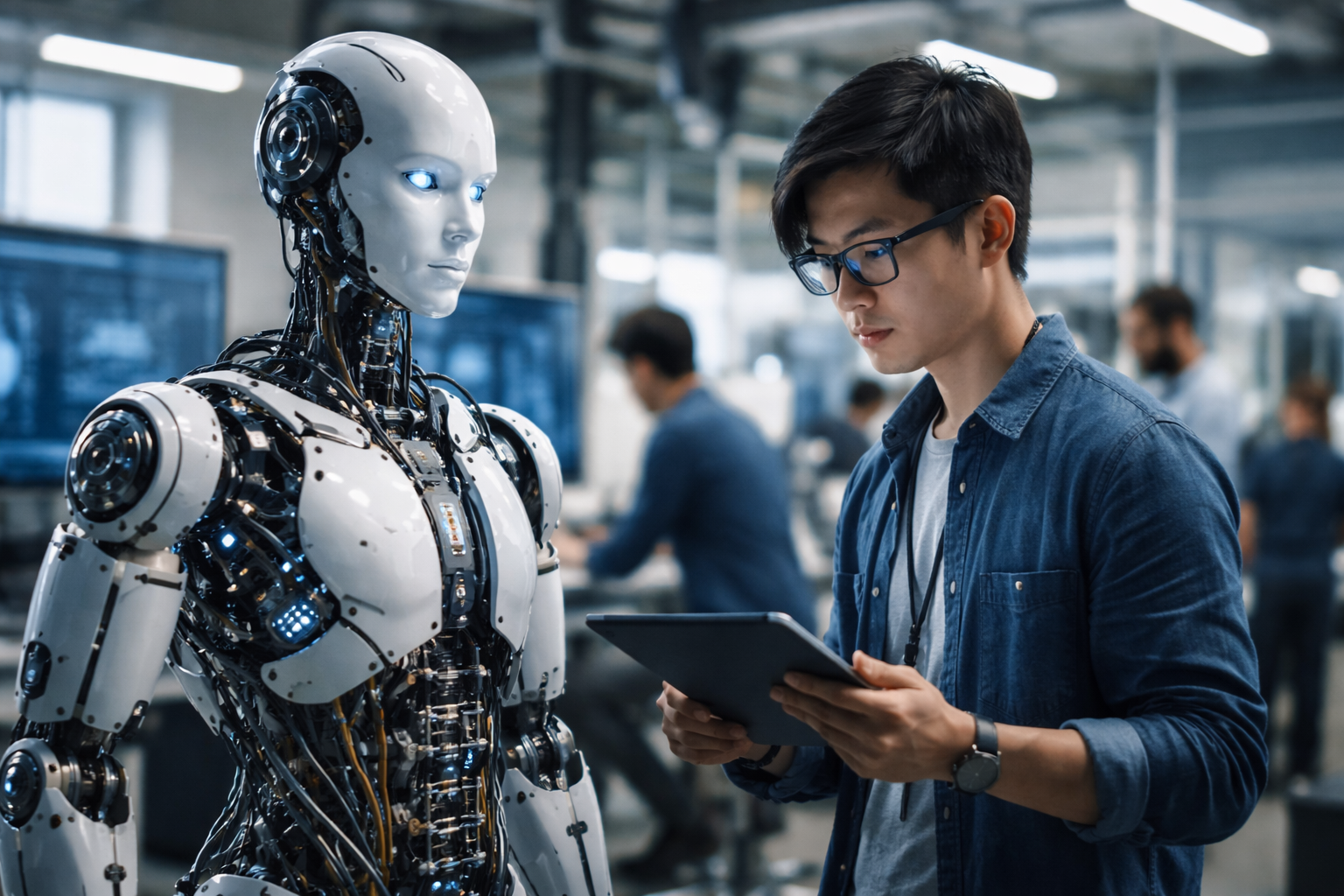
Automation at Scale: How AI Is Reshaping Work – and Why the Future of Jobs Is Under Pressure
A Turning Point for Human Labor
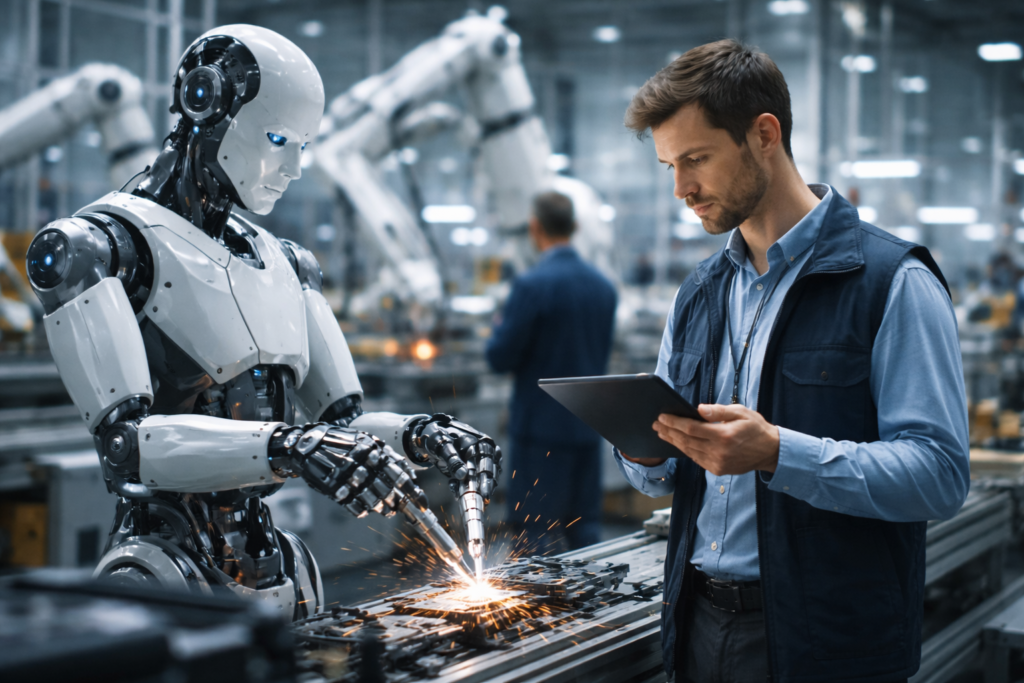
Artificial intelligence–powered automation has moved decisively beyond factory floors and repetitive mechanical tasks. Today, algorithms draft legal documents, write software code, analyze financial markets, moderate online content, generate marketing copy, and even assist in strategic decision-making. This expansion has triggered a renewed debate about the future of work—one no longer confined to blue-collar displacement, but increasingly centered on white-collar, knowledge-based professions.
Unlike previous waves of automation, AI-driven systems do not merely replace physical labor; they replicate and scale cognitive functions. As organizations adopt these systems at unprecedented speed, concerns over job displacement, skill obsolescence, wage polarization, and long-term economic stability have intensified.
This article explores how AI-powered automation is transforming labor markets, which jobs are most exposed, how businesses and governments are responding, and whether this technological shift will ultimately erode or redefine human employment.
Understanding AI-Powered Automation
What Makes AI Automation Different?
Traditional automation followed explicit rules. AI automation, by contrast, relies on probabilistic models that learn patterns from data and improve autonomously.
Key characteristics include:
- Adaptability: Systems adjust behavior based on new data.
- Scalability: Once deployed, AI can perform tasks across millions of instances at near-zero marginal cost.
- Cognitive substitution: Tasks involving analysis, prediction, and content generation are now automatable.
This marks a structural break from earlier technological disruptions, which primarily affected manual and routine clerical work.
Jobs at Risk: Beyond the Factory Floor
High-Exposure Occupations
Contrary to early assumptions, the most vulnerable roles are not necessarily low-skilled jobs.
Research indicates elevated exposure in:
- Administrative and clerical roles
- Customer service and support
- Junior software development
- Accounting and auditing
- Content moderation and basic journalism
Many of these roles involve predictable patterns, standardized outputs, and high data availability—ideal conditions for AI automation.
Partial Automation vs. Full Displacement
Importantly, AI rarely eliminates entire jobs outright. Instead, it automates task clusters within occupations.
For example:
- A paralegal may spend less time on document review but more on legal analysis.
- A software engineer may rely on AI for boilerplate code while focusing on system architecture.
- A marketing analyst may shift from data processing to strategic interpretation.
This fragmentation complicates workforce forecasting and policy planning.
White-Collar Anxiety and the Knowledge Economy

Why Professional Workers Are Concerned
For decades, education was viewed as insulation against automation. AI challenges this assumption.
Factors driving concern include:
- Rapid improvement in large language models
- AI’s ability to generate “good enough” outputs at scale
- Corporate incentives to reduce labor costs
In sectors such as media, law, consulting, and finance, AI systems increasingly function as substitutes rather than tools—especially at entry and mid-level positions.
The Risk of Career Ladder Collapse
One emerging concern is the erosion of traditional career pipelines.
If AI automates:
- Junior analyst work
- Entry-level legal research
- Basic reporting and content drafting
Then organizations may struggle to train future senior professionals, creating long-term talent gaps despite short-term efficiency gains.
Productivity Gains vs. Employment Losses
The Economic Promise of Automation
Proponents argue that AI automation:
- Increases productivity
- Lowers operational costs
- Enables economic growth
- Creates new job categories
Historically, technological revolutions have eventually generated more jobs than they destroyed.
Why AI May Be Different
Several factors complicate this historical analogy:
- Speed of adoption: AI deployment is faster than workforce retraining.
- Skill mismatch: New jobs require advanced, specialized skills.
- Concentration of gains: Productivity benefits accrue disproportionately to capital owners and large firms.
As a result, job creation may lag behind job displacement, at least in the medium term.
Labor Market Polarization and Inequality
The “Barbell” Effect

AI automation is accelerating labor market polarization:
- High-skill, high-pay roles: AI architects, data scientists, system designers
- Low-skill, non-automatable roles: Care work, manual services, in-person tasks
- Middle-skill roles: Increasingly hollowed out
This “barbell” structure risks widening income inequality and social instability.
Wage Pressure and Bargaining Power
As AI substitutes for human labor:
- Workers face reduced bargaining power
- Wage growth stagnates in automatable sectors
- Freelance and gig-based work expands
This shift challenges traditional employment protections and labor relations frameworks.
Corporate Strategy: Efficiency First
Why Companies Are Moving Fast
From a corporate perspective, AI automation offers:
- Predictable output
- Lower long-term costs
- Reduced dependency on labor markets
- Competitive advantage
In an environment of economic uncertainty, automation is often framed as a defensive necessity rather than a strategic choice.
Ethical Commitments vs. Market Pressure
While many firms publicly commit to “responsible AI” and workforce upskilling, execution often lags behind rhetoric—particularly when shareholder expectations prioritize short-term returns.
Policy and Regulatory Responses
Government Interventions Under Discussion
Policymakers are exploring a range of responses, including:
- Large-scale reskilling and upskilling programs
- AI impact assessments for major deployments
- Labor protections for displaced workers
- Taxation of automated labor
- Shorter workweeks and job-sharing models
However, regulatory capacity often trails technological change.
Education Systems Under Strain
Current education and training models struggle to adapt to:
- Rapidly changing skill demands
- Lifelong learning requirements
- Cross-disciplinary AI literacy
Without structural reform, education risks becoming misaligned with labor market realities.
The Human Advantage: What AI Cannot Easily Replace
Despite rapid advances, AI systems remain limited in several domains:
- Complex social interaction
- Ethical judgment
- Emotional intelligence
- Contextual decision-making under uncertainty
- Creativity rooted in lived experience
Roles emphasizing these capabilities are likely to remain resilient—though not immune to transformation.
Reframing the Question: Not “Jobs vs. AI,” but “Work with AI”
Toward a New Social Contract
The core challenge is not whether AI will automate work, but how societies choose to distribute its benefits.
Key questions include:
- Who captures productivity gains?
- How is economic security maintained?
- What role should work play in human identity?
Answering these questions requires coordination between governments, businesses, labor organizations, and civil society.
An Unsettled Future
AI-powered automation is reshaping the labor market with a speed and scope unmatched by previous technological revolutions. While it promises efficiency and economic growth, it also threatens job security, exacerbates inequality, and destabilizes long-standing career structures.
The future of work will not be determined by technology alone, but by the choices societies make in response to it. Whether AI becomes a force for broad-based prosperity or deepening division depends on governance, investment in human capital, and a willingness to rethink the relationship between labor, value, and technology.
What is clear is that the era of assuming work will naturally adapt to innovation has ended. The transition now underway demands deliberate, informed, and collective action.
References
- International Labour Organization (ILO) – Generative AI and Jobs
- OECD – Artificial Intelligence and the Future of Work
- World Economic Forum – Future of Jobs Report
- MIT Work of the Future Task Force
- McKinsey Global Institute – Automation and employment studies