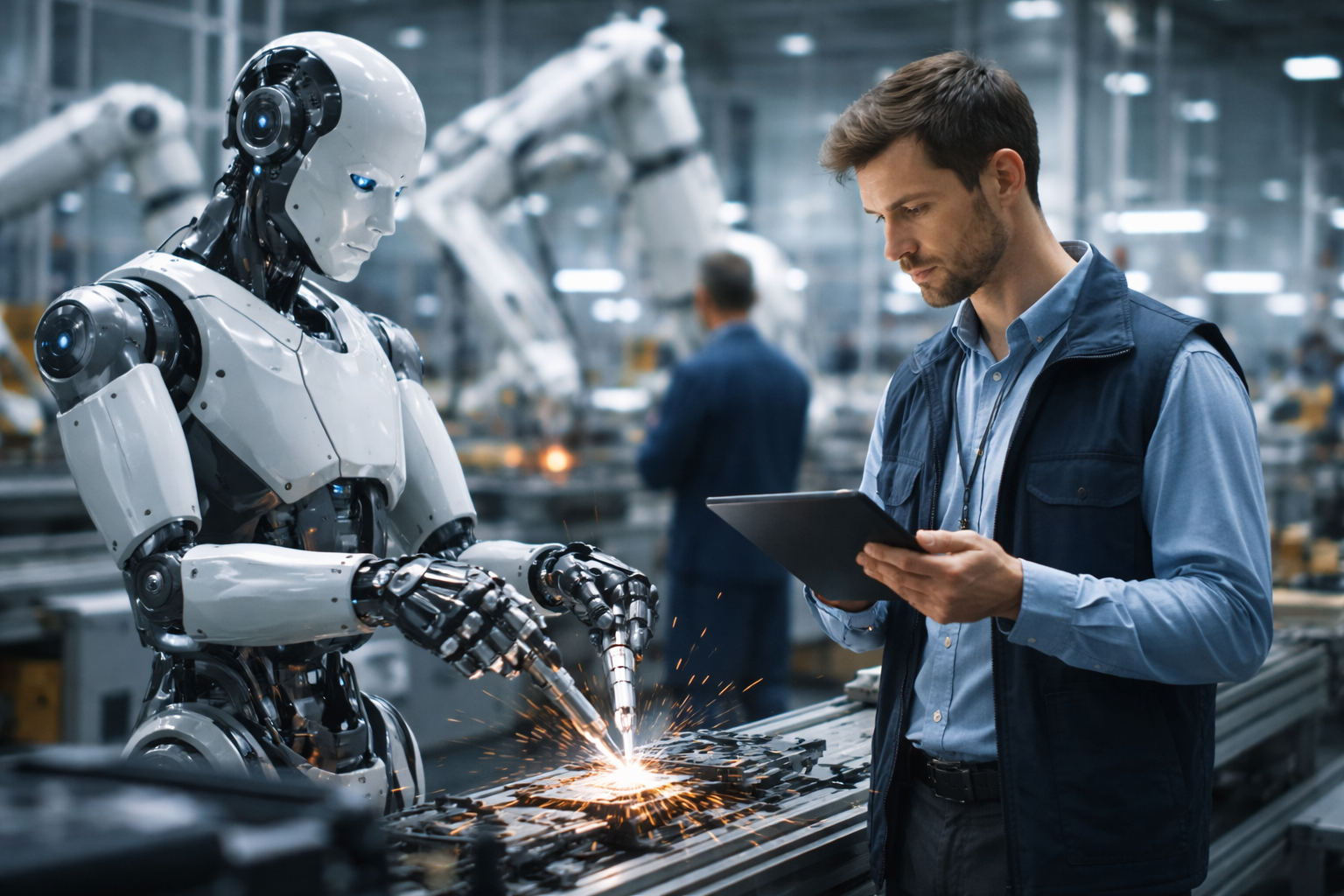
How AI and Emerging Technologies Are Reshaping Industry, Work, and Society
Introduction

Artificial intelligence (AI) and emerging technologies have moved from experimental labs into daily operations across industries. From generative AI copilots in software development to autonomous systems in logistics and predictive analytics in healthcare, the current technological wave is characterized by rapid adoption, evolving regulatory scrutiny, and deep structural change. According to the Stanford AI Index Report and McKinsey Global Institute, investment in AI continues to accelerate while organizations shift from pilot projects to production-scale deployment.
This article examines the current landscape of AI and emerging technologies through a semi-technical, journalistic lens. It explores how core technologies are evolving, where economic value is being created, the risks and governance challenges organizations face, and what trends may shape the next phase of digital transformation. Rather than focusing on hype cycles, the analysis centers on operational realities and measurable impacts across sectors.
The Technology Stack Driving the AI Era
AI is no longer a single technology but a layered ecosystem composed of data infrastructure, model architectures, deployment platforms, and edge devices. Understanding this stack is essential to grasping why adoption has accelerated so quickly.
Foundation Models and Generative Systems
Large-scale neural networks—commonly called foundation models—have become a core enabler. Built using transformer architectures and trained on massive datasets, these models support multiple downstream applications:
- Natural language processing and conversational interfaces
- Image and video generation
- Code synthesis and debugging
- Multimodal analysis combining text, audio, and visual data
The shift toward generative capabilities marks a departure from earlier narrow AI systems. Instead of solving one task, foundation models provide flexible platforms that can be adapted through fine-tuning or prompt engineering.
According to the Stanford AI Index (2024–2025), generative AI investment surged dramatically after 2022, reflecting enterprise interest in automation and productivity enhancement.
Data Engineering and MLOps
Behind the scenes, scalable data pipelines and machine learning operations (MLOps) frameworks enable production deployments. Organizations increasingly rely on:
- Data lakes and distributed storage architectures
- Continuous integration/continuous deployment (CI/CD) pipelines for models
- Monitoring tools that detect model drift and bias
- Synthetic data generation for training when real datasets are scarce
Without this infrastructure, AI remains experimental. As reported by Gartner, operational maturity—not algorithmic innovation—is now the primary differentiator between organizations successfully scaling AI and those stuck in proof-of-concept phases.
Hardware Acceleration and Edge Computing
Advances in specialized processors—GPUs, TPUs, and AI accelerators—have dramatically reduced training and inference times. Simultaneously, edge computing allows AI workloads to run locally on devices such as industrial robots, smartphones, and connected vehicles.
This distributed computing paradigm offers:
- Reduced latency
- Improved privacy through on-device processing
- Greater resilience in environments with limited connectivity
The convergence of hardware innovation and model optimization is enabling real-time AI applications previously considered impractical.
Industry Transformation: Where AI Is Creating Tangible Value
While AI’s potential spans nearly every sector, the pace and nature of adoption vary depending on regulatory constraints, data availability, and operational complexity.
Healthcare: Predictive and Personalized Care
AI applications in healthcare increasingly focus on diagnostics, patient monitoring, and drug discovery. Examples include:
- Deep learning models detecting anomalies in medical imaging
- Predictive analytics forecasting patient deterioration
- Generative AI assisting clinical documentation
A Nature Medicine review highlights AI’s growing role in medical imaging accuracy and workflow efficiency, although regulatory oversight remains strict due to patient safety concerns.
Finance: Automation Meets Risk Management
Financial institutions use AI for fraud detection, algorithmic trading, and customer service automation. Machine learning models analyze transaction patterns to identify anomalies in real time.
Key benefits include:
- Reduced operational costs through automation
- Improved risk modeling
- Enhanced customer personalization
However, regulators increasingly scrutinize algorithmic decision-making to ensure fairness and transparency, as noted by the Bank for International Settlements (BIS).
Manufacturing and Supply Chain: Smart Operations
Industrial AI focuses on predictive maintenance, robotics, and supply chain optimization. Sensors embedded in equipment generate continuous data streams that models analyze to forecast failures.
According to McKinsey, predictive maintenance alone can reduce machine downtime by up to 30% and lower maintenance costs by 10–20%.
Media, Marketing, and Creative Industries
Generative AI tools have reshaped content production workflows. Automated copywriting, video editing assistance, and personalized advertising strategies have become common.
Yet this shift has sparked debates about intellectual property rights and content authenticity, prompting discussions around watermarking and AI-generated media labeling.
The Changing Nature of Work

The integration of AI into everyday workflows is redefining roles rather than simply replacing them. Most organizations adopt AI to augment human capabilities rather than eliminate entire job categories.
Productivity Augmentation
Studies from MIT Sloan Management Review indicate that AI tools can significantly accelerate routine tasks such as:
- Data analysis and reporting
- Software testing
- Customer support responses
- Drafting technical documentation
Workers increasingly act as supervisors of automated systems, validating outputs and focusing on complex decision-making.
Skills Evolution and Workforce Adaptation
Demand for new skills is growing in areas such as:
- Prompt engineering and AI system configuration
- Data literacy and analytics interpretation
- Human-AI collaboration workflows
- Ethical risk assessment
Organizations investing in training programs report faster adoption and fewer implementation failures. Upskilling initiatives are often more cost-effective than large-scale hiring.
Labor Market Disruption and Policy Considerations
Although automation raises concerns about job displacement, most economists predict task-level transformation rather than wholesale elimination. The World Economic Forum Future of Jobs Report suggests that while some administrative roles may shrink, new positions in AI governance, cybersecurity, and digital operations will expand.
Governance, Ethics, and Regulation
As AI capabilities grow, governance frameworks are evolving rapidly to address safety, fairness, and accountability.
Algorithmic Transparency and Bias
Bias in training data can lead to discriminatory outcomes. Organizations increasingly implement:
- Model explainability techniques (e.g., SHAP values, LIME)
- Fairness auditing protocols
- Diverse training datasets
Regulators emphasize documentation and risk assessment, especially for high-impact systems in finance, healthcare, and hiring.
Data Privacy and Security
Data protection laws such as the EU’s General Data Protection Regulation (GDPR) influence how organizations collect and process personal information. AI models trained on sensitive data must incorporate privacy-preserving techniques like differential privacy or federated learning.
Emerging Regulatory Frameworks
Governments worldwide are developing AI-specific legislation. The European Union’s AI Act introduces risk-based classification systems, while the U.S. focuses on sector-specific guidelines and executive directives.
Companies deploying AI globally must navigate:
- Cross-border data compliance
- Industry-specific safety standards
- Intellectual property implications for generated content
The Rise of Autonomous and Intelligent Systems
Beyond generative tools, autonomous systems represent another frontier in emerging technology.
Robotics and Physical Automation
Robots equipped with computer vision and reinforcement learning algorithms are increasingly deployed in warehouses, agriculture, and healthcare environments. Autonomous drones monitor infrastructure, while collaborative robots (“cobots”) assist human workers on assembly lines.
Autonomous Vehicles and Mobility Platforms
Although fully autonomous consumer vehicles remain under development, AI-powered driver assistance systems are already common. Logistics companies experiment with self-driving delivery vehicles and AI-assisted fleet management to optimize routing and fuel efficiency.
Smart Cities and Infrastructure
Urban planners integrate AI into traffic management, energy grids, and public safety systems. Predictive analytics help reduce congestion and improve emergency response times. However, surveillance concerns require careful policy design to balance efficiency with civil liberties.
Risks, Limitations, and Unresolved Challenges
Despite rapid progress, AI adoption comes with substantial risks that organizations must address.
Technical Constraints
- Hallucinations and factual inaccuracies: Generative models may produce plausible but incorrect outputs.
- Data dependency: Performance relies heavily on data quality and representativeness.
- Model interpretability challenges: Complex architectures can make decision processes opaque.
Economic and Operational Risks
- High computational costs for training large models
- Vendor lock-in with proprietary AI platforms
- Integration difficulties with legacy IT systems
Social and Ethical Concerns
- Deepfakes and misinformation campaigns
- Workforce inequality due to uneven access to training
- Concentration of AI power among a few large technology firms
The OECD AI Principles emphasize responsible innovation, accountability, and human-centered design to mitigate these risks.
Key Takeaways
- AI adoption has shifted from experimentation to enterprise-scale deployment, driven by advances in foundation models and hardware acceleration.
- Industry transformation is uneven, with healthcare, finance, manufacturing, and media experiencing different adoption patterns.
- Human-AI collaboration is redefining work, emphasizing skill evolution rather than mass job displacement.
- Governance and regulation are expanding, particularly around transparency, bias mitigation, and data privacy.
- Autonomous systems represent the next frontier, integrating AI into physical environments.
- Challenges remain, including technical limitations, operational costs, and societal risks.
Conclusion
AI and emerging technologies are no longer theoretical disruptors; they are foundational components of modern digital infrastructure. The convergence of advanced machine learning models, scalable computing, and ubiquitous data has accelerated adoption across industries, transforming workflows and creating new economic opportunities.
However, this transformation is neither uniform nor risk-free. Organizations must balance innovation with governance, ensuring systems remain transparent, fair, and secure. Policymakers face the challenge of regulating rapidly evolving technologies without stifling beneficial experimentation. Meanwhile, workers and educational institutions must adapt to a labor market where technical literacy and interdisciplinary collaboration are increasingly essential.
Looking ahead, the trajectory of AI will likely be shaped less by breakthroughs in algorithms and more by how effectively organizations integrate technology into real-world operations. Success will depend on robust infrastructure, ethical frameworks, and sustained investment in human skills.
Rather than a single technological revolution, the current moment represents a long-term transition toward intelligent systems embedded throughout society. Understanding both the opportunities and the constraints is critical for businesses, policymakers, and individuals navigating an increasingly AI-driven world.
References & Sources
- Stanford Institute for Human-Centered AI — AI Index Report (latest editions)
- McKinsey Global Institute — The Economic Potential of Generative AI and Industry Transformation Analyses
- Gartner — Research on AI Operationalization and Enterprise Adoption Trends
- MIT Sloan Management Review — Studies on Human-AI Collaboration and Productivity
- World Economic Forum — Future of Jobs Report
- Nature Medicine — Reviews on AI Applications in Healthcare
- OECD — Principles on Artificial Intelligence
- Bank for International Settlements (BIS) — AI in Financial Services Reports